Bins — Supply & Install

Litter & Recycling Bins in Cape Town

Precast concrete and galvanised steel bins for complexes, office parks, schools and retail centres — supplied, anchored down properly, and the surface made good afterwards. All from one contractor.

Request a Quote
Round precast concrete litter bin with a black liner hood, installed on block paving

Supplied and Installed

Bins That Stay Put and Actually Get Emptied

Two things sink a bin installation: units that are not anchored, and units the cleaning crew cannot service. We fix both at the specification stage — bolting down into the right substrate with the right anchor, and specifying liners that lift straight out.

As a building contractor we also make the surface good around every fixing, fit the signage, and can refurbish your existing bins instead of replacing them where the bodies are still sound.

The Range

Litter, Recycling and Pole-Mounted Bins

Sizes and finishes can be made to spec — send us your drawing or a site photo and we will come back with what fits.

Concrete Bins

Mass is the anti-theft and anti-vandalism feature. Concrete bins stay where you put them, survive being knocked, and never need recoating — the trade-off is weight, so placement needs planning.

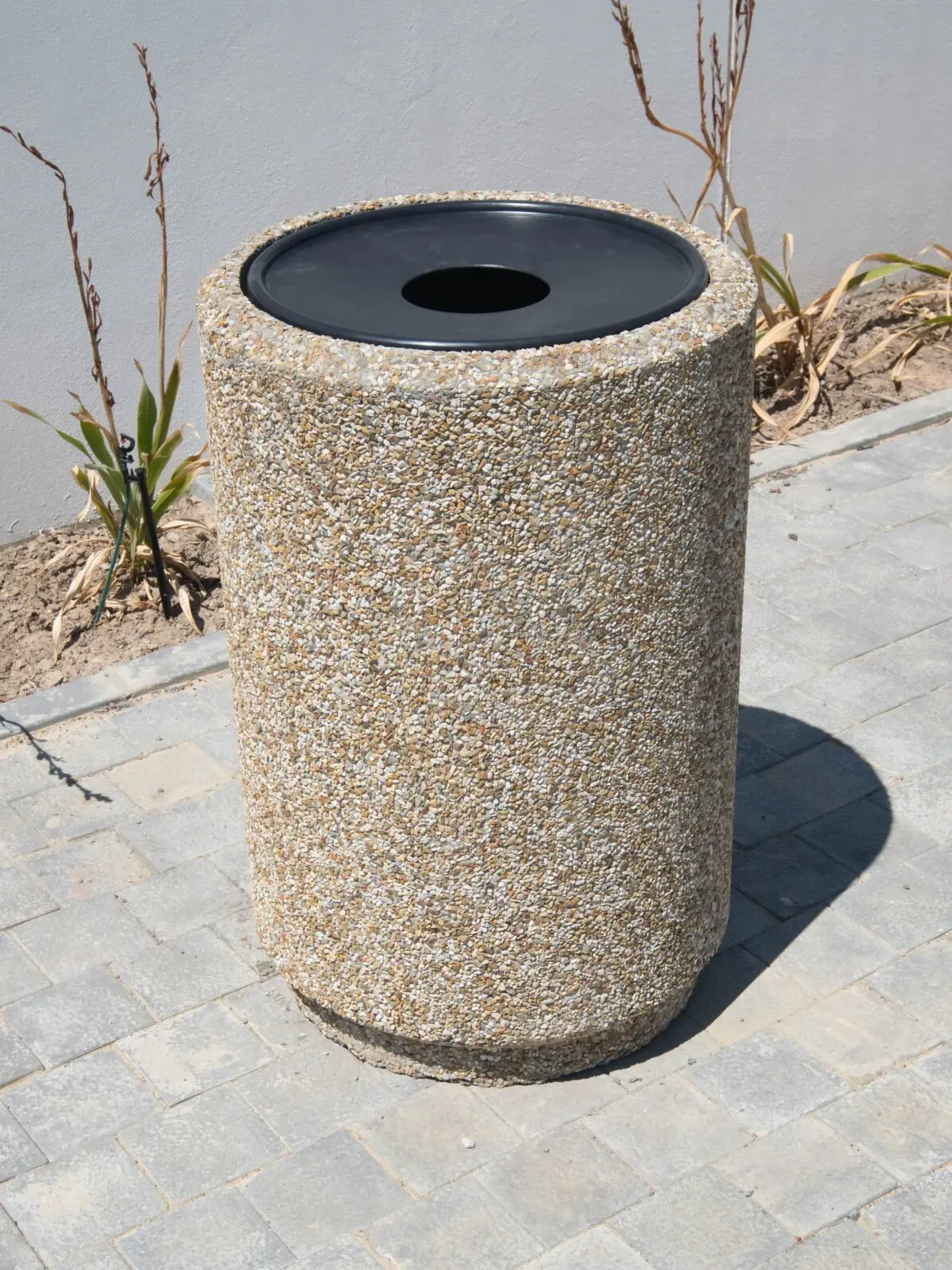
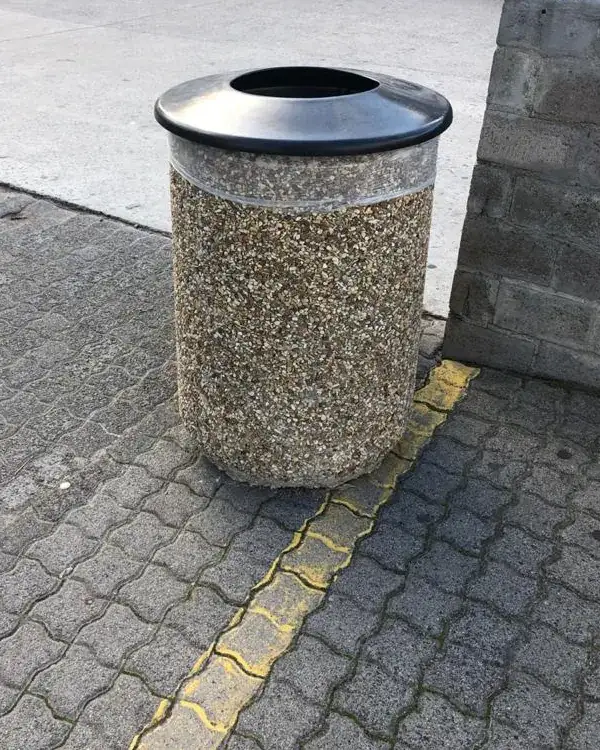
Round 600 precast concrete litter bin with a black moulded lid, on block paving

Round 600 Concrete Bin with Lid

600mm across and 150 litres — the larger of the round concrete bins, and at 250kg heavy enough that it stays where it is put. The moulded lid keeps rain off the contents and narrows the opening, which discourages people emptying household bags into a street bin.

  • 600mm Ø × 900mm high
  • 150 litre capacity
  • Precast concrete, 250kg
  • Moulded lid with drop-in aperture

Finish: Exposed aggregate as pictured, off-shutter or painted to your colour

Request a Quote
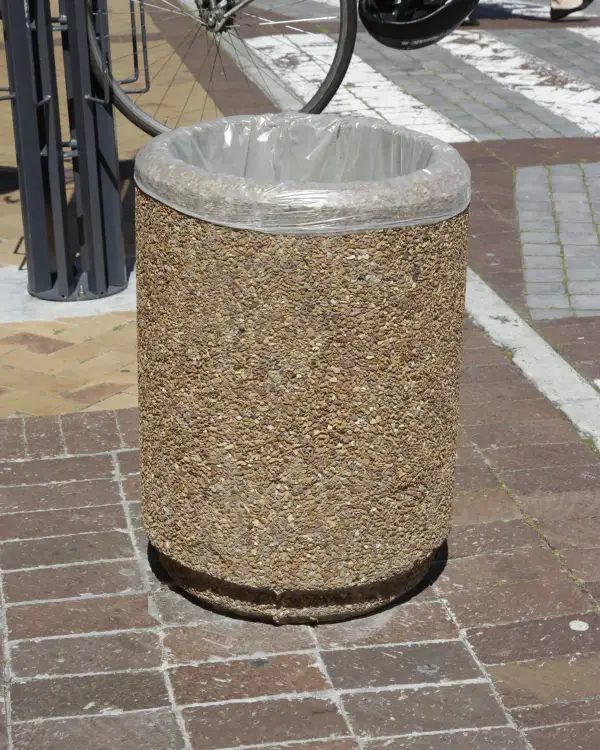
Round 500 precast concrete open-top litter bin with a bag liner over the rim, on street paving

Round 500 Concrete Bin

The open-top version — no lid, with the bag liner simply folded over the rim, which turns emptying into a few seconds for a crew working a street round. Smaller than the 600 at 500mm across and 750mm high, and it sits on the surface rather than in a footing.

  • 500mm Ø × 750mm high
  • Precast concrete, 185kg
  • Open top — no lid
  • Bag liner folds over the rim

Finish: Exposed aggregate as pictured, off-shutter or painted to your colour

Request a Quote
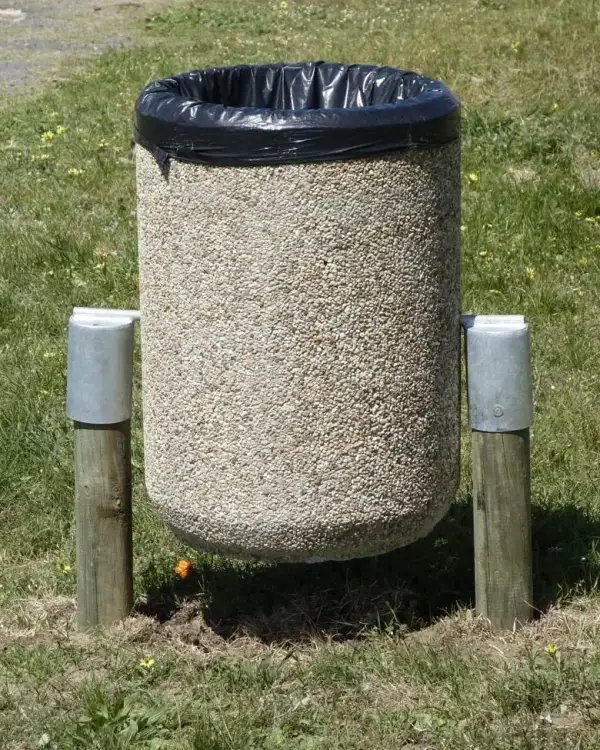
Round 500 swing concrete bin slung between two posts on galvanised brackets, with a black bag liner over the rim

Round 500 Swing Concrete Bin

The same 500mm concrete body, but slung between two posts on galvanised brackets so the whole bin pivots forward to empty rather than someone lifting a wet liner up over the rim. It also hangs clear of the ground, so there is nothing to sweep or mow around and no damp ring left where the base sat.

  • 500mm Ø × 750mm above ground
  • 75 litre capacity
  • Precast concrete on galvanised swing brackets
  • Pivots forward to empty — no lifting out

Finish: Exposed aggregate as pictured, off-shutter or painted to your colour

Request a Quote
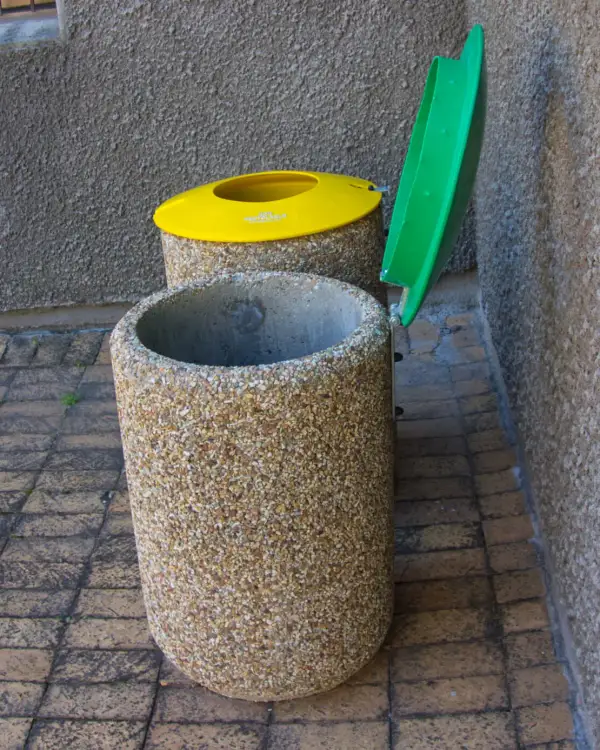
Round 500 concrete bin with a green hinged lid swung open on its bracket, a second bin with a closed yellow lid behind it

Round 500 Concrete Bin with Hinged Lid

Same 500mm body and same 185kg as the open-top Round 500, but with the lid on a galvanised hinge instead of dropped loose over the rim — which matters, because the loose lid is always the part that goes missing. It swings right back for emptying and stays with the bin while the crew works. Allow for that swing when you place it: the lid needs somewhere to fall back to, so it suits a wall behind rather than being boxed into a tight corner.

  • 500mm Ø × 750mm above ground
  • Precast concrete, 185kg
  • Moulded lid on a galvanised hinge bracket
  • Lid swings back and stays attached

Finish: Exposed aggregate as pictured, with a coloured lid for recycling colour-coding

Request a Quote
Round 500 concrete bin with a black removable lid with a central aperture, a bag liner folded over the rim beneath it, on forecourt paving

Round 500 Concrete Bin with Removable Lid

The same 500mm body and 185kg again, with the lid simply dropped over the liner rather than hinged. Lift it off and the whole rim is open, which is the quickest way to change a bag, and there is no hinge to seize up or get levered off. The trade is the obvious one: a lid that lifts off is a lid that can be walked off with, so it suits enclosed or supervised positions better than an open street.

  • 500mm Ø × 750mm above ground
  • Precast concrete, 185kg
  • Removable moulded lid with a drop-in aperture
  • Bag liner folds over the rim under the lid

Finish: Exposed aggregate as pictured, with the lid in black or a recycling colour

Request a Quote
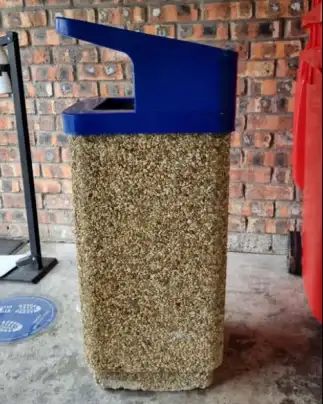
Square 405 precast concrete bin with a blue powder-coated steel canopy cantilevered over the opening

Square 405 Concrete Bin with Canopy

A steel canopy cantilevered over the opening, so rain stays out and litter does not blow back out in the south-easter. Worth knowing what the hood costs you in volume though — 39 litres inside a 165kg bin, so on a busy route it wants emptying more often than the round bins do. It earns its place in exposed, windy positions where an open bin just redistributes its contents.

  • 405 × 405mm × 760mm above ground
  • 39 litre capacity
  • Precast concrete, 165kg
  • Steel canopy with side opening

Finish: Exposed aggregate as pictured, canopy powder-coated to your colour

Request a Quote
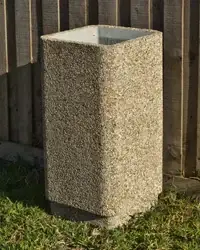
Square 400 open-top precast concrete bin with a chamfered cast rim, standing on grass against a timber fence

Square 400 Concrete Bin

The square counterpart to the Round 500 — same idea, no lid, but a narrower footprint that sits better against a wall or along a walkway where a round bin eats into the walking width. Open top means it empties in seconds on a cleaning round, and there is nothing on it to break or be levered off.

  • Square open-top precast concrete body
  • Chamfered cast rim, no lid
  • Sits on the surface — no footing needed
  • Dimensions and capacity confirmed at quote

Finish: Exposed aggregate as pictured, off-shutter or painted to your colour

Request a Quote
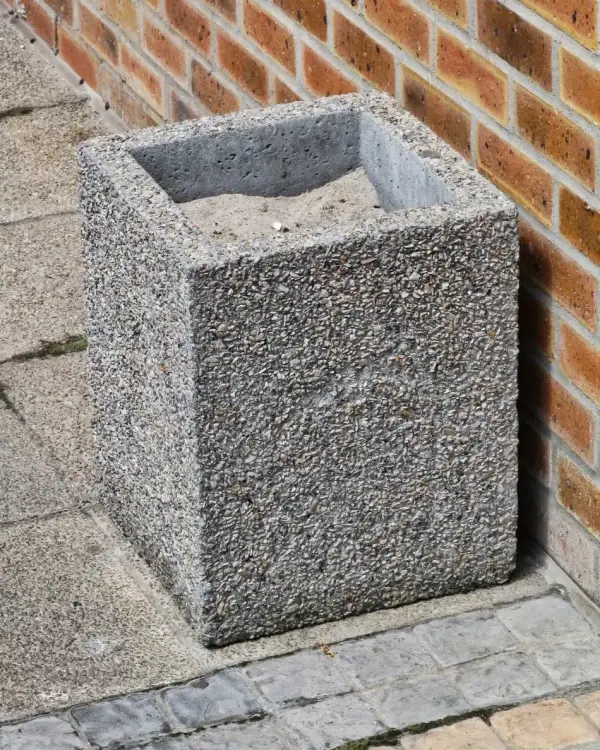
Square ash concrete bin in exposed aggregate, sand-filled, standing against a face-brick wall on setts paving

Square Ash Concrete Bin

Sand-filled, so a stub goes out where it lands instead of smouldering in with the paper — which is the whole reason to keep ash off the litter bin at an entrance. Same 400mm square body as the Square 400, so a pair either side of a doorway reads as one set, and 750mm is a comfortable height to use without stooping.

  • 400 × 400mm × 750mm above ground
  • 35 litre capacity
  • Precast concrete, open top
  • Takes a sand fill for stubbing out

Finish: Exposed aggregate as pictured, off-shutter or painted to your colour

Request a Quote
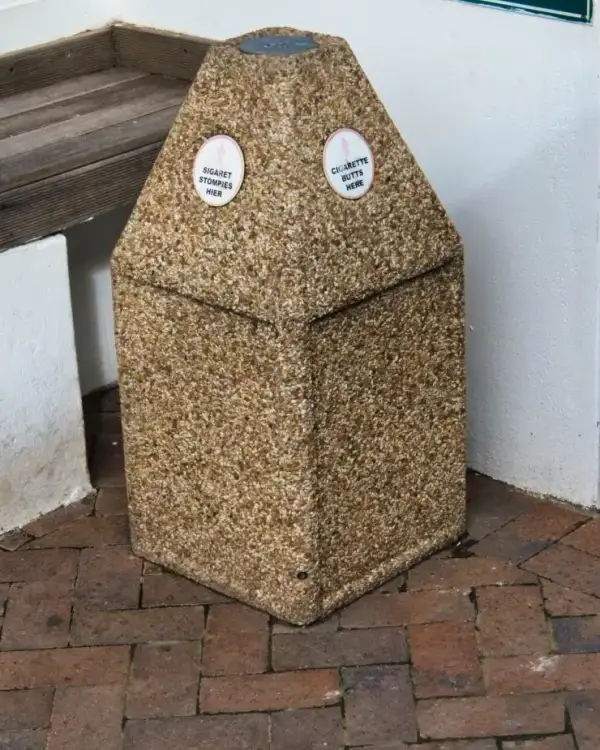
Pyramid ash concrete bin in exposed aggregate with a steel stubbing plate at the apex and bilingual cigarette-butt decals, on brick paving

Pyramid Ash Concrete Bin

The pyramid is the point — no flat top, so nobody parks a coffee cup, a bottle or themselves on it, and rain runs straight off instead of pooling in the ash. Stubs go out on the steel plate at the apex and drop through into the body below. At 245kg it is not going anywhere either, which matters outside a bar or a function venue at closing time.

  • 400 × 400mm × 750mm above ground
  • Precast concrete, 245kg
  • Steel stubbing plate at the apex
  • Sloped cap — nothing can be left on top

Finish: Exposed aggregate as pictured, off-shutter or painted to your colour

Request a Quote
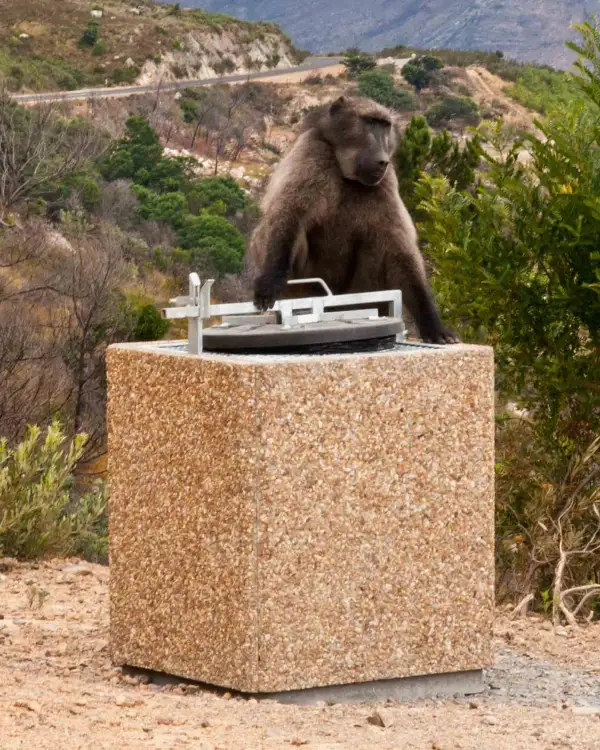
Baboon-proof square precast concrete bin with a latching steel lid, a chacma baboon sitting on top of it beside a Cape Peninsula mountain road

Baboon-Proof Concrete Bin

For the parts of the Peninsula where an ordinary bin is really just a feeding station. The lid is weighted and latched so a troop cannot lever, slide or tip it open, and the body is heavy enough that it does not get rolled — which is what actually keeps refuse off the verge in Simon’s Town, Scarborough, Kommetjie and along the Tokai and Constantia edges.

  • Square precast concrete body
  • Weighted steel lid with a baboon-proof latch
  • Mesh grille beneath the lid
  • Dimensions and capacity confirmed at quote

Finish: Exposed aggregate as pictured, off-shutter or painted to your colour

Request a Quote
Steel Bins

Lighter and quicker to service, and the only route to a swing, wall-mounted or perforated bin. Hot-dip galvanised for anywhere near the sea, powder-coated where a bin has to match a scheme's colours or carry recycling colour-coding.

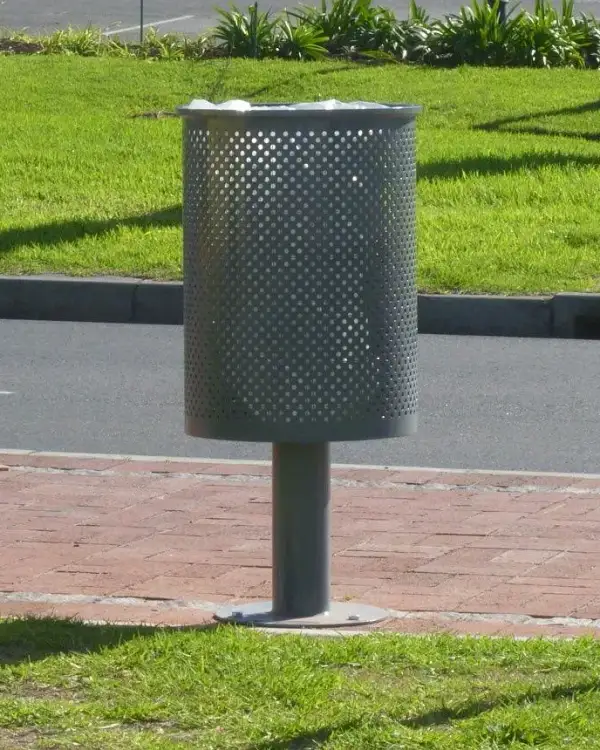
Perforated steel pedestal bin on a bolted baseplate, standing on brick paving beside a kerb and grass verge

Perforated Pedestal Steel Bin

The steel option, and a different argument entirely: 300mm across on a single pedestal, so it takes up almost no walking width and sits clear of the ground with nothing to sweep or mow around. The perforated body drains rather than collecting a puddle in the bottom, and you can see at a glance whether it needs emptying. It has none of the concrete bins' mass, though, which makes the fixing the whole job — anchored properly into the slab it stays where it is put, and a bin this light that is not anchored properly walks.

  • 300mm Ø × 760mm high
  • Perforated steel body on a pedestal
  • Bolt-down baseplate — nothing below ground
  • Capacity confirmed at quote

Finish: Galvanised as pictured, or powder-coated to your colour

Request a Quote
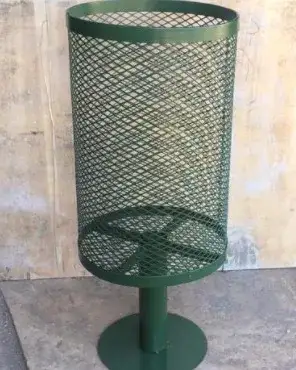
Flattex round steel bin in green powder-coated expanded mesh, open top, mounted on a pedestal with a circular base plate

Flattex Round Steel Bin

The same 300mm footprint as the perforated pedestal bin but 900mm tall, which buys 75 litres out of the same bit of pavement. The expanded mesh drains completely and shows at a glance when the bin is full — the flip side being that anything wet or fine goes straight through it, so this one wants a liner rather than being used bare. At 8kg it is light enough for one person to carry in, which keeps installation cheap across a large order and equally means it is only ever as good as its fixing: bolted down through the base plate as shown, or planted into the ground where you would rather not drill the paving.

  • 300mm Ø × 900mm above ground
  • 75 litre capacity
  • Expanded steel mesh body, 8kg
  • Base plate as shown, or planted in the ground

Finish: Powder-coated green as pictured, or to your colour

Request a Quote
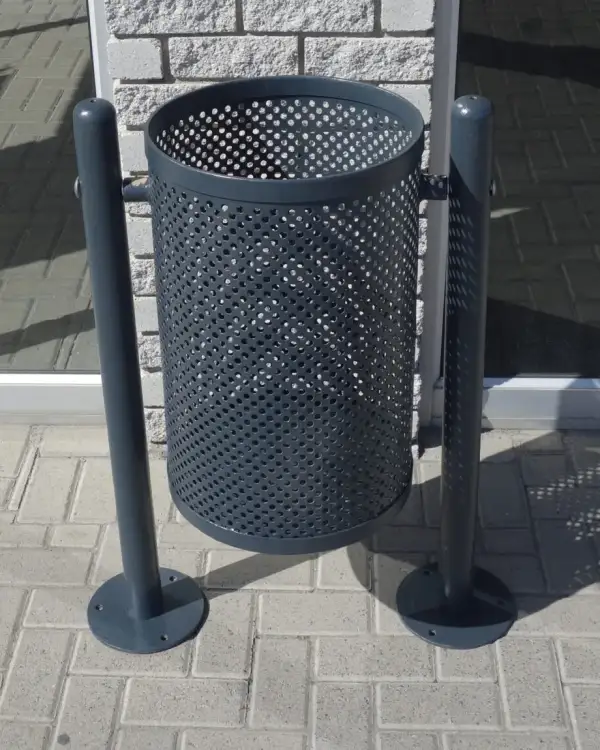
Dual leg swing steel bin — a perforated steel bin body slung between two powder-coated posts on bolt-down base plates, on block paving outside a shopfront

Dual Leg Swing Steel Bin

The steel counterpart to the Round 500 Swing: a perforated body slung between two posts on pivot brackets, so it tips forward to empty rather than someone lifting a wet liner up over the rim. Hanging it clear of the ground is the real gain — nothing to sweep or mow around, no damp ring left on the paving, and the perforations drain instead of holding water in the bottom. Both posts land on bolt-down base plates, so it goes onto existing paving without digging; it has none of the concrete swing bin's mass to fall back on, though, so the anchors are doing all the work.

  • 900mm above ground
  • 75 litre capacity
  • Perforated steel body on twin swing posts
  • Bolt-down base plates — pivots forward to empty

Finish: Powder-coated as pictured, or to your colour

Request a Quote
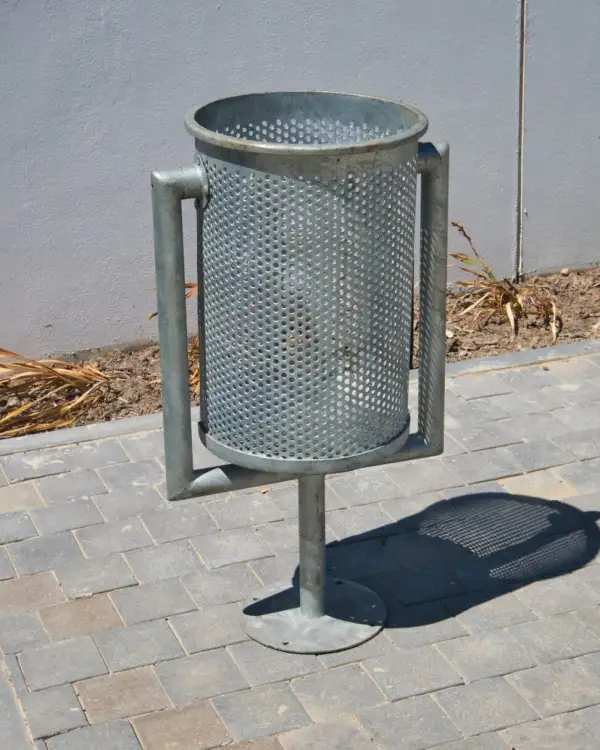
Perforated swing steel bin — a galvanised perforated bin body pivoting in a yoke on a single post with a round bolt-down base plate, on block paving

Perforated Swing Steel Bin

The same swing action as the dual leg version but carried on one post, which halves the footprint and leaves a single base plate to anchor — worth having where the walkway is narrow or the bin has to sit tight against a wall. 390mm across and 600mm deep for the same 75 litres, hung at 750mm so the body tips forward into a bag without anyone stooping over it. It comes hot-dip galvanised rather than painted, which is the right specification anywhere within reach of the sea; the trade against the dual leg is that the whole load goes through one set of anchors, so what is under that base plate matters more.

  • 390mm Ø × 600mm body
  • 75 litre capacity
  • 750mm above ground on a single post
  • Bolt-down base plate — pivots forward to empty

Finish: Hot-dip galvanised as pictured, or powder-coated to your colour

Request a Quote
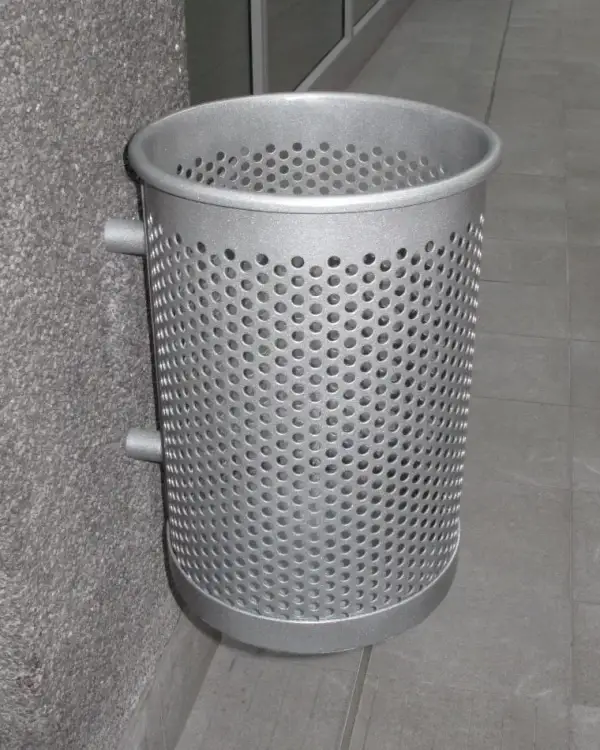
Perforated wall mounted steel bin in a silver powder-coated finish, bracketed off an exposed-aggregate concrete column and hanging clear of the floor of a covered walkway

Perforated Wall Mounted Steel Bin

The one bin here with no footprint at all — it cantilevers off two brackets into a wall or column, so it takes nothing off the walking width and a cleaner can run a machine straight underneath it. That suits arcades, walkways, stair landings and lobbies where a freestanding bin either blocks the route or ends up shoved out of the way. At 300mm across and 450mm deep it holds 30 litres, the smallest in the range, so it works as a top-up point rather than a main bin. The fixing is the whole job on this one: 30 litres of rubbish plus somebody leaning on it is a real pull-out load, and brick, block and concrete each want a different anchor.

  • 300mm Ø × 450mm body
  • 30 litre capacity
  • Wall or column mounted on two brackets
  • Hangs clear of the floor — nothing to sweep around

Finish: Powder-coated as pictured, or hot-dip galvanised

Request a Quote
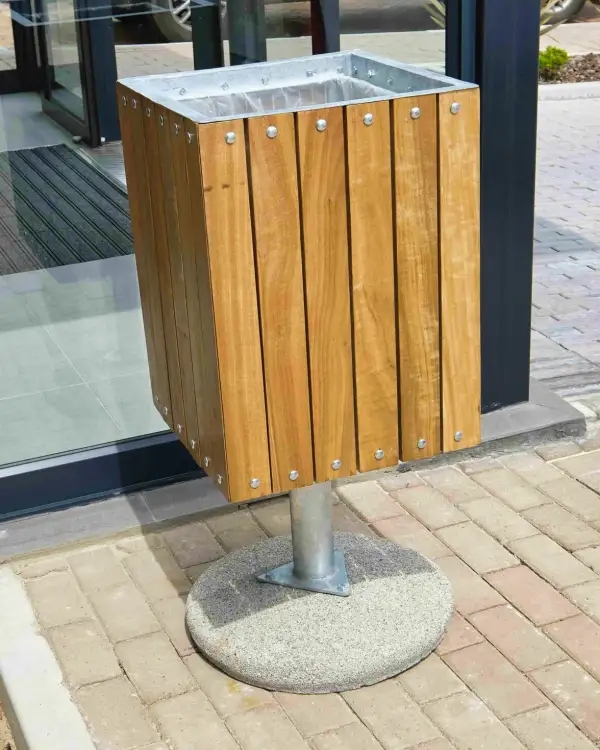
Square slatted steel bin — hardwood slats on a galvanised steel frame with a galvanised rim and liner, on a post set into a round precast concrete base, on brick paving at a building entrance

Square Slatted Steel Bin

The one bin here that is not trying to look industrial — hardwood slats on a galvanised frame, which is why it turns up at office park entrances and reception forecourts where bare galvanised or concrete reads as back-of-house. Same 400 × 400mm footprint as the Square 400 and Square Ash concrete bins, so the three sit together as a set, and 75 litres inside a galvanised rim that the liner drops in behind. It is shown standing on a weighted precast base, which puts it down on existing paving without drilling and lets you move it later. The timber is the honest caveat: in Cape Town sun it silvers off within a season or two unless somebody re-oils it, so either budget for that or accept the grey — it is the only thing on this page that asks for maintenance.

  • 400 × 400mm × 760mm above ground
  • 75 litre capacity
  • Hardwood slats on a galvanised steel frame
  • Shown on a weighted precast base — no drilling

Finish: Oiled hardwood with a galvanised frame — re-oiled, or left to silver

Request a Quote
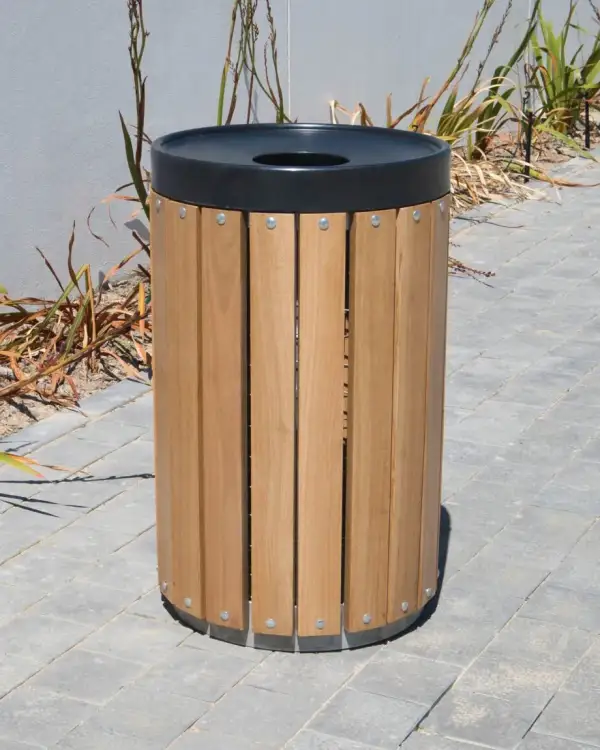
Round timber slatted steel bin — hardwood slats on a galvanised steel frame with galvanised bands and a black moulded lid with a central aperture, standing on block paving beside a planted bed

Timber Slatted Steel Bin Round

The round version, and the one to take if volume actually matters — 500mm across and 125 litres against 75 in the square, which is most of what the 250kg Round 600 concrete bin swallows without any of its weight. It differs in the other useful way too: a moulded lid with a drop-in aperture, so rain stays off the contents and the narrowed opening discourages somebody emptying a household bag into a street bin. It stands on the paving as pictured rather than on a post, which leaves placement free and makes anchoring a decision rather than a given — worth taking on an open street. Same timber caveat as the square: re-oil it, or let it go silver.

  • 500mm Ø × 800mm above ground
  • 125 litre capacity
  • Hardwood slats on a galvanised steel frame
  • Moulded lid with a drop-in aperture

Finish: Oiled hardwood with a galvanised frame and a black lid

Request a Quote
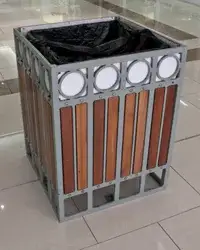
Timber slatted square bin — timber slat infill panels in a grey powder-coated steel frame with a band of ringed discs around the top, open top with a black liner, standing on a tiled floor

Timber Slatted Bin Square

The decorative one: a powder-coated steel frame with timber slats as infill panels and a band of ringed discs around the top, rather than the plain hardwood body of the Square Slatted. It is the larger square as well — 450 × 450mm and 100 litres against 400mm and 75 — and it stands on its own legs with the liner dropped in behind the frame. The powder coat is the difference worth using: this is the one to colour-match to a centre's scheme, where the galvanised bins will always read as site furniture. Two finishes to keep up rather than one, though — the coating on the frame and the oil on the slats — so it suits a covered walkway or an atrium better than an exposed street corner.

  • 450 × 450mm × 750mm above ground
  • 100 litre capacity
  • Timber slat infill in a powder-coated steel frame
  • Open top — liner drops in behind the frame

Finish: Powder-coated frame with oiled timber slats, colour to your scheme

Request a Quote

Materials & Finishes

Built for a Wet, Dirty, Outdoor Life

Bins get the worst conditions of any site furniture — permanently damp, permanently dirty, and regularly knocked. Material and finish choice is what decides whether they last three years or fifteen.

Precast Concrete

Mass is the anti-theft and anti-vandalism feature. Concrete bins stay where you put them, survive being knocked, and never need recoating — the trade-off is weight, so placement needs planning.

Hot-Dip Galvanised Steel

The right call within reach of the sea, and the right call for liners anywhere. Bins live in a permanently wet, permanently dirty environment, and hot-dip galvanising is the only finish that reliably handles it.

Powder-Coated Steel

Where the bins have to match a scheme's colours or carry recycling colour-coding. Specify it over galvanised steel — powder coat straight onto bare steel will not last on a Cape Town site.

Liners & Servicing

Every bin we supply takes a removable liner. It sounds minor until you have watched a cleaning crew try to empty a fixed concrete bin — liner choice drives whether a bin actually gets serviced.

Installation

What the Installation Actually Covers

Everything below is in the quote. You should not be arranging a separate contractor to patch the paving or fit the signage after your bins are delivered.

  • Placement planned around cleaning routes, pedestrian flow and where litter actually accumulates
  • Bolt-down fixing into slabs and paving with chemical or expansion anchors where theft is a risk
  • Core-drilling and cast-in fixing for pole-mounted units
  • Wall brackets fixed into brick, block or concrete with the correct anchor for the substrate
  • Making good the surface around every fixing — paving, concrete or asphalt matched back in
  • Recycling signage, colour-coding and aperture labelling supplied and fitted
  • Repainting and refurbishment of existing bins as part of a maintenance programme

How It Works

From Site Visit to Making Good

Six steps, one contractor, one firm price.

01

Site Visit

We walk the site with you, look at where litter collects, how the cleaning crew moves, and what the substrate is at each proposed position.

02

Spec & Layout

We recommend bin type, capacity, liner and fixing per position, and mark up a layout so nothing lands somewhere awkward to service.

03

Firm Quote

One itemised quote covering supply, fixing, making good and signage. The number on the quote is the number you pay.

04

Supply

We source or cast the units and confirm lead times upfront, including any custom colours or branded signage.

05

Install

Fixing, anchoring and mounting, scheduled around residents, tenants or trading hours where the site cannot stop.

06

Make Good

Surfaces reinstated, signage fitted, site cleared, and a walkthrough with you before we leave.

Bin Supply & Installation FAQs

What Cape Town facilities managers, trustees and business owners ask before ordering bins — anchoring, liners, recycling streams and refurbishment.

Do you supply bins only, or install them too?

Both. Supply-and-install is the usual choice because bolting bins down properly, and making good the paving afterwards, is building work. We will quote supply only if you have your own team for the fixing.

Can bins be bolted down so they are not stolen or moved?

Yes, and we recommend it in any public or semi-public area. We anchor into the slab or paving with chemical or expansion anchors depending on the substrate, and make the surface good around each fixing.

Do the bins come with liners?

Yes. Every bin we supply takes a removable inner liner — usually galvanised. It is the single biggest factor in whether a bin actually gets emptied properly, so we treat it as standard rather than an extra.

Can you supply recycling bins with separated streams?

Yes. Twin-bin recycling stands with colour-coded, labelled apertures are the usual starting point, and we can supply signage matched to your building's recycling scheme.

Do you supply baboon-proof bins?

Yes. The usual answer is a precast concrete body with a weighted, latching steel lid — heavy enough not to be rolled over, and with no edge a baboon can get a hand under. The fixing matters as much as the lid: we anchor into the slab or paving and make the surface good around each fixing, because a bin that can be tipped is not baboon-proof whatever the lid does. This comes up most in Simon’s Town, Scarborough, Kommetjie and along the Tokai and Constantia edges, where an ordinary open or hooded bin gets emptied onto the verge and turns into a daily cleaning job.

Can bins be branded or colour-matched?

Yes. Powder-coating in a specified colour is straightforward, and we can fit signage or plates carrying a complex name, estate branding or recycling instructions.

Do you refurbish existing bins rather than replace them?

Often that is the better spend. If the bodies are sound we strip, treat and recoat them on site and replace the liners — which is usually a fraction of the cost of a full replacement. We will tell you honestly which way makes more sense.

Do you work with body corporates and managing agents?

Regularly. We quote per phase so trustees can approve the spend, schedule around residents, and provide the documentation managing agents need for their records.

What guarantee do I get?

Our installation carries the same 12-month workmanship guarantee as the rest of our building work — if a fixing or the making good fails in that time we come back and fix it at no charge. The bins carry their manufacturer terms, and we tell you what those are before you order.

Still have questions? We're here to help!

Contact Us

What you're guaranteed

Four promises, in writing, before any work starts.

  • The Firm Price Promise

    Pay the number on your quote. Nothing is added without your approval first.

  • 12-Month Workmanship Guarantee

    Get any workmanship defect fixed free within 12 months of handover.

  • One Name, Start to Finish

    Deal with the owner who quoted your job — first visit to final walkthrough.

  • Straight Advice First

    Hear what your money is better spent on, even when that means a smaller job for us.

Need Bins Supplied and Installed?

Send us a site photo or a drawing and we will come out, mark up the positions and quote the whole job — supply, fixing and making good.

Areas We Supply & Install

We supply and install bins across Cape Town — the Southern Suburbs, Northern Suburbs, Atlantic Seaboard and the city's industrial precincts. If your area isn't listed below, get in touch; chances are we cover it too.

Residential Suburbs

Not sure if we cover your area? Reach out for a free site visit and quotation.

Request a Quote
TOP